Knowledge Center
Technical writing on aquatic biogeochemistry, contaminant fate, and the chemistry behind treatment decisions.
The Redox Switch — A Learner's Guide to Underwater Chemical Triggers
A millimeter-thick zone at the sediment-water interface decides whether phosphorus, manganese, arsenic, and methylmercury stay locked in your sediment or release into the water column. Glue, mirror, sentinel, switch — and the four questions every internal-loading project has to answer.
Read the Insight →All Insights
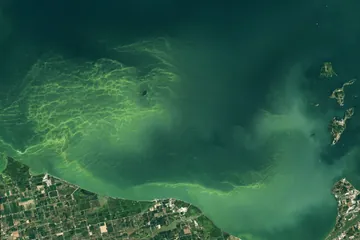
Reading a Decade of Lake History from Orbit
Forty years of free, orbital, multi-spectral imagery already exists for your lake. Used as a screening layer, it answers questions a single year of in-situ sampling cannot.
Reading the Sediment: A Diagnostic Primer
What lake sediment actually tells you — and why a one-time TP measurement misses the diagnostic that matters.
The Right Test, the Right Interpretation: A Monitoring Framework
Most monitoring programs measure what is easy to measure, not what answers the question. The cost is years of data that cannot diagnose the problem they were collected to solve.
What a Real Lake Management Plan Actually Contains
Most 'lake management plans' are wish lists. We walk through the sections, sequencing, and success criteria that distinguish a real plan from a brochure.
Phosphorus Inactivation: Choosing Between Alum, Phoslock, and EutroSORB
The right inactivant for your lake is determined by your chemistry, not by the seller closest to your zip code. A diagnostic walk through the three dominant options.
Internal vs External: How to Tell Where Your Nutrients Are Coming From
Watershed BMPs vs. in-lake inactivation: the wrong choice is expensive. Mass balance is the diagnostic that tells you which lever actually moves your lake.
Building a HAB Response Plan Before You Need One
When a bloom is actively producing toxins is not the time to invent your response. A practical template for the plan you wish you'd written.
Why Most Aeration Systems Don't Work (And How to Tell If Yours Does)
The failure modes are predictable. The diagnostic is straightforward. Most installed systems would fail it.
Cyanotoxins in Drinking Water: The Long-Term Management Question
Four toxin families, four mechanisms, two time horizons. Why chronic cyanotoxin management is a nutrient-cycling problem, not an event-response problem — and what that means for drinking-water risk.
Sequencing Treatments: Why Order Matters in Lake Restoration
The right treatments applied in the wrong order cancel each other out. Sequence in lake restoration is a chemistry decision that quietly determines whether the whole program works.
The Real Cost of a Lake Treatment Program
The sticker price of a lake treatment is the least important number in the decision. The real cost is the program — and the recurring spend a misdiagnosis locks you into for a decade.
Predicting What a Treatment Will Actually Do to Your Lake
A lake treatment is a chemical perturbation with consequences far beyond its target. Predicting the side effects before you dose is the difference between a fix and a new problem you paid to create.
Post-Treatment: What to Measure and When
Treatments rarely fail mysteriously — they fail without a monitoring design that could have caught the rebound or proved the result. What to measure after treatment, and why timing decides whether you know anything at all.
Will That Wetland Actually Work? The Chemistry of Nature-Based Solutions
Nature-based solutions don't escape chemistry. A wetland either has the redox conditions to bind phosphorus, or it doesn't — and the design is the difference.
The Hidden Cost of Killing Aquatic Weeds
Aquatic weed kills release nutrients on a predictable timeline. The HAB that follows is not bad luck — it is the chemistry of the kill.
Taste, Odor, and the Algae Behind Your Customer Complaints
Geosmin and MIB are made by cyanobacteria in your reservoir at parts-per-trillion. Chasing them at the plant is the expensive way to lose. The control point is upstream.
The Manganese Problem at Your Drinking Water Plant Starts Upstream
Mn breakthrough is a sediment chemistry problem before it is a plant chemistry problem. Source-water intervention is usually the cheapest fix.
Reducing Coagulant Demand Through Source Water Optimization
Coagulant demand is driven by the organic carbon your reservoir delivers — the same organics that become DBP precursors. Cutting the load at source is usually the better economics than chasing it at the plant.
Source Water Strategy: Optimizing the Reservoir to Cut Plant Costs
Reservoir-side management is treatment plant economics by other means. We walk the framework for an integrated program.
What a Real Geochemical Site Characterization Looks Like
A site characterization is the foundation of every remediation decision. Done right, it answers the questions the regulator hasn't yet asked.
From Concentrations to Conclusions: Heavy Metals Data Forensics
Heavy metals data is rarely self-explanatory. The forensic interpretation that turns numbers into a defensible narrative is the deliverable.
PHREEQC in Practice: Modeling Where Contaminants Actually Go
PHREEQC is the workhorse of inorganic fate modeling. The piece walks through how we use it in practice — not in tutorial.
Total Concentration Is the Wrong Question: Releasability and Bioaccessibility
Total metal concentrations answer the wrong question. Releasability and bioaccessibility answer the right one — and they often disagree with the total.
Following the Mercury: Isotope Forensics and Methylation Hotspots
Total mercury is the wrong metric. Methylation is the risk driver, and mercury isotopes — δ²⁰²Hg and Δ¹⁹⁹Hg — are the closest thing to a fingerprint for source allocation, regulatory negotiation, and remediation targeting.
Mitigation in Phases: Sequencing a Real Remediation
A phased remediation outperforms a single-shot one on cost and outcome. The sequencing logic is chemistry-led.
Choosing a Treatment Technology That Will Actually Work
Technology selection is a chemistry exercise. The most expensive failure mode is the technology that doesn't match the water it sees.
Lifecycle Cost of Remediation: How to Justify the Right Solution
Lifecycle economics is the only way to compare a $2M capital project to a $200K/yr operating one. We walk the framework.
Bioremediation for Metals: Designing Sulfate-Reducing Bioreactors
Sulfate-reducing bioreactors are the lowest-energy long-term sink we have for many metals. The design is half chemistry, half plumbing.
Sequestering Arsenic and Antimony in Place: The Stabilization Chemistry
Arsenic and antimony are oxyanions, not cationic metals — the remedies that immobilize lead and zinc can mobilize them. The stabilization chemistry that actually holds, and when in-situ beats excavation.
Predicting AMD Before You Have a Problem
AMD prediction done in the design phase is a fraction of the cost of AMD treatment done in the operating phase. A primer on the prediction toolkit.
Active or Passive? Choosing an AMD Treatment Approach
There is no universal best AMD treatment. There is, for each site, a best one — chosen on chemistry, flow, and lifecycle.
Tailings as a Liability Asset: Characterization for Closure
Closure-ready tailings characterization is a different exercise from operational characterization. The deliverable answers different questions.
Closure Water Quality: Planning for the Next 100 Years
Closure planning is the most expensive engineering decision a mine ever makes. Geochemistry is the constraint that drives it.
The Pit Lake You Will Inherit: Trajectory Modeling Across Decades
A pit lake is a decades-long chemistry experiment that starts the day pumping stops. Whether it stratifies, what its walls leach, and where it ends up are forecastable — and the forecast is the document that sets your closure bond and perpetual-treatment liability.